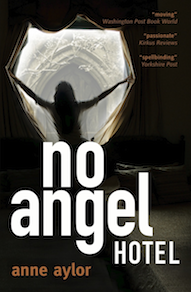
Due to the success of The Double Happiness Company, BareBone Books will reissue Anne Aylor’s first novel in February 2012. When No Angel Hotel was first published it was compared to the novels of Jean Rhys and received excellent reviews on both sides of the Atlantic.
No Angel Hotel has received a striking new cover, designed by Line of Sight in Toronto. Watch this space for the publication date of this revised edition which will be available in paperback and as an eBook.
‘Anne Aylor’s first novel is a finely crafted and moving exploration of the youthful pain and the lasting passion of love. She tells the tale of Elkie, a working-class girl from Northern Ireland and her affair with a sophisticated intellectual, Ivan, “like Count Vronsky with dark hair”. Ivan’s interest is casual and self-indulgent, but Elkie, misunderstanding and in love, wants to go off with him. In a moment of frustration, Ivan agrees. What follows is a series of drab rented rooms, brief visits, a fading hope of marriage, a dozen years of nothing but occasional postcards, and then a final, fateful postcard.’ —WASHINGTON POST BOOK WORLD
On 28 August 2011 Anne Aylor’s novel, The Double Happiness Company, was launched in the United States. A book signing was held in the Cultural Center de Mesilla, hosted by its director, Denise Chavez, an award-winning writer who also runs the annual Border Book Festival in Mesilla, New Mexico. Mil gracias to Denise for making it a wonderful fiesta that included a cake iced with the cover of our first publication!
The National Public Radio Station KTEP, which is based in El Paso, Texas, wanted a second interview with novelist Anne Aylor about her book, The Double Happiness Company, which is largely set in the borderlands of the American Southwest. Hear her 14-minute conversation with presenter Mónica Gómez:
Our first novel, The Double Happiness Company, has been chosen by 7DayWonder as one of the books under discussion on their “Booklovers Holiday” in September 2011. If you are already a fan of The Double Happiness Company, or want to discover what a great book it is, you will have a unique holiday in Catalonia with books, good food, conversation in a baronial stone farmhouse. Check it out here.
A punchy 2-minute video remix using only the sounds of an energetic dance workout. Inspired by dance novel The Double Happiness Company, this film was created by Eclectic Method in NYC.
New York-based video remixers, Eclectic Method who performed at the Grammy Awards in LA this year, had the idea of promoting The Double Happiness Company with a video featuring “raw dance”. The piece was conceived by Jonny Wilson of EM and was made in collaboration with the Purchase College Dance Department, State University of New York, with dancers Jessica Miller and Oliver Greene-Cramer.
Jonny wanted to make a film of “what you hear in a ballet studio, sounds you never hear because of the music”. His promo video will be released in a few weeks. Here is Eclectic Method preparing to film Raw Dance Remix.
Multi-talented author and dancer, Anne Aylor, talks about her new novel, The Double Happiness Company, on KTEP, El Paso’s National Public Radio Station’s “State of the Arts” programme. Hear her 8-minute interview:
Author Anne Aylor has been interviewed recently on BBC Radio Solent speaking about her new book, The Double Happiness Company. To hear further interviews on Manx Radio or Radio Talk Europe, click here.
This short film was made on the night of the launch of Anne Aylor’s new novel. This excellent video was shot and edited by Kieran Conlan of Realta Productions, London.
‘A brilliant novel. I couldn’t put it down. A remarkable insight into the relationships between women and the novel captures perfectly some of the underlying reasons for conflicts between mothers and daughters. Anne Aylor creates an extraordinary “monster mother” and slowly reveals her true nature. The novel is a warning to all women about how easy it is to trust the wrong women in your life. For men, it will be a revelation about how women’s lives can be dominated by their image of their bodies. But in the end it is a great novel about love.‘ Dorothy Byrne, Head of News & Current Affairs, Channel 4 TV and who spoke at the launch
‘Anne’s writing demonstrates her powers of observation. Dialogue throughout is pitch perfect, and gives Anne some of her pithy chapter headings: “Weirdnik in a tutu”, “Fatso goes Nutzoid”. A keen eye selected the well-chosen period detail: Tangee lipstick, beaded curtains, black-bottom pie, the Frontier coffee shop full of stuffed animals, a velvet picture of Jackie O. All in all, this book is a delight. Read, and enjoy.’ Annemarie Neary, writer, ZenAzzurian and a Bridport prizewinner in 2009
‘I cannot thank you enough, Anne, for last night. What a privilege it was for me to be offered the stage to give a testament of my experience of you. You have no idea how honoured I feel to be associated with someone like you, whose vision, creative power, focus, dedication and graciousness I have drunk like water from a rare wellspring.’ Eugene Skeef, South African percussionist, composer, poet & cultural activist
‘Amazing night last night – just wanted to say WOW. Congratulations and big thanks for having such a great party!‘ Elise Valmorbida of Word Design (left)
‘It was a truly wonderful launch. The readings whetted my appetite for the book, which I began on the way home. I’m hooked! The story can’t fail to draw people in. I thought the venue was fantastic – that marvellous balcony which meant we could all see and hear the speakers. And the music was a lovely touch – again very rare. And delicious food, and, you Anne, looking so glamourous, with your great whoosh of magnificent burnished hair. I wish you and the book every possible success. Black Swan, move out of the way – you’re going to be surpassed!‘ Wendy Perriam, author of 16 novels (most recently Broken Places) & 7 short story collections
‘I am so so soooo happy to have been at the event with your and your dear friends. A beautiful experience! I thank you and the universe for letting us meet. Muchas gracias por tu libro, Anne. Y por tus palabras, un abrazo, un beso.’ Bel Bellvehi Negre of the Bel and Sammy Duet, Figueres, Spain
‘A brilliant book launch. The readings were great, the speeches were great. It felt like BareBone Books had existed for ages, it was such a confident event. It was really good to see your work come to fruition and be celebrated.’ Andrea Michell, Bravura Films
‘Congratulations on a fantastic launch last night!‘ Claire Richman, Senior Account Manager, Midas PR
‘Looked like a very successful night, even to a bibliophobe like me! Best wishes to Anne for the book. Judging by the queue to get it signed yesterday, it’s a winner.’ Robin Beste
‘I wanted to thank you both for including me in this very special event. I felt very honoured to be part of it.’ Nikki Redmond, actor
If you type “The Double Happiness Company” in double quotation marks in Google today, the fifth entry, page 2 is the Double Happiness Tyre Company who manufacture 1.8 million pairs of truck tyres per year.
The seventh entry on page 2 lists the Shanghai-based Double Happiness Company which manufactures 60% of the world’s table tennis balls, 80% of table tennis competition balls and 3 million table tennis bats annually. They also make badminton rackets, shutllecocks and weight-lifting barbells. Their annual turnover is in excess of $50 million.
BareBone Books first publication, Anne Aylor’s new novel, The Double Happiness Company, which has yet to be released, sits above companies on Google who measure production levels and profits in the millions.
In doing research for this post I was interested to discover that Potter Style have recently published a box of cards called “Double Happiness Fortune Cookie Note Cards” which can be ordered from Amazon.
Seeing this stationery item piqued my interest in fortune cookies whose origins are obscure. Take your choice from these three versions: A) David Jung, a Chinese immigrant living in Los Angeles invented the fortune cookie in 1918. He handed them out to the poor he saw in the streets outside his shop. B) A Japanese immigrant, Makoto Hagiwara, invented the cookie in San Francisco in 1914.
But my favourite story is “C” that says that fortune cookies are of Chinese origin. In the 13th and 14th centuries, China was occupied by the Mongols. Chu Yuan Chang, a patriotic revolutionary of the time, planned an uprising against their occupiers. To inform his conspirators of the date of the revolt, rice paper messages were hidden in moon cakes which contained a “yolk” of lotus paste the Mongols didn’t like to eat. The uprising was successful and the Ming Dynasty was born.
Whichever of these stories is true, what we know as the fortune cookie in its contemporary form only arrived in China in the 1990s and was advertised there as “genuine American fortune cookies.” The biggest fortune cookie company is based in LA and makes 60 million Chinese fortune cookies a month. Beats the table tennis balls. Two of my favourite wacky fortunes are “Don’t kiss an elephant on the lips today” and ”The rubber bands are heading in the right direction”.
Ben Okri discusses writing (“I think the purpose of what we’re trying to do in art, finally, is to enchant the human heart and mind into a sense of its true kingdom of magnificence”) and his novel, Starbook.
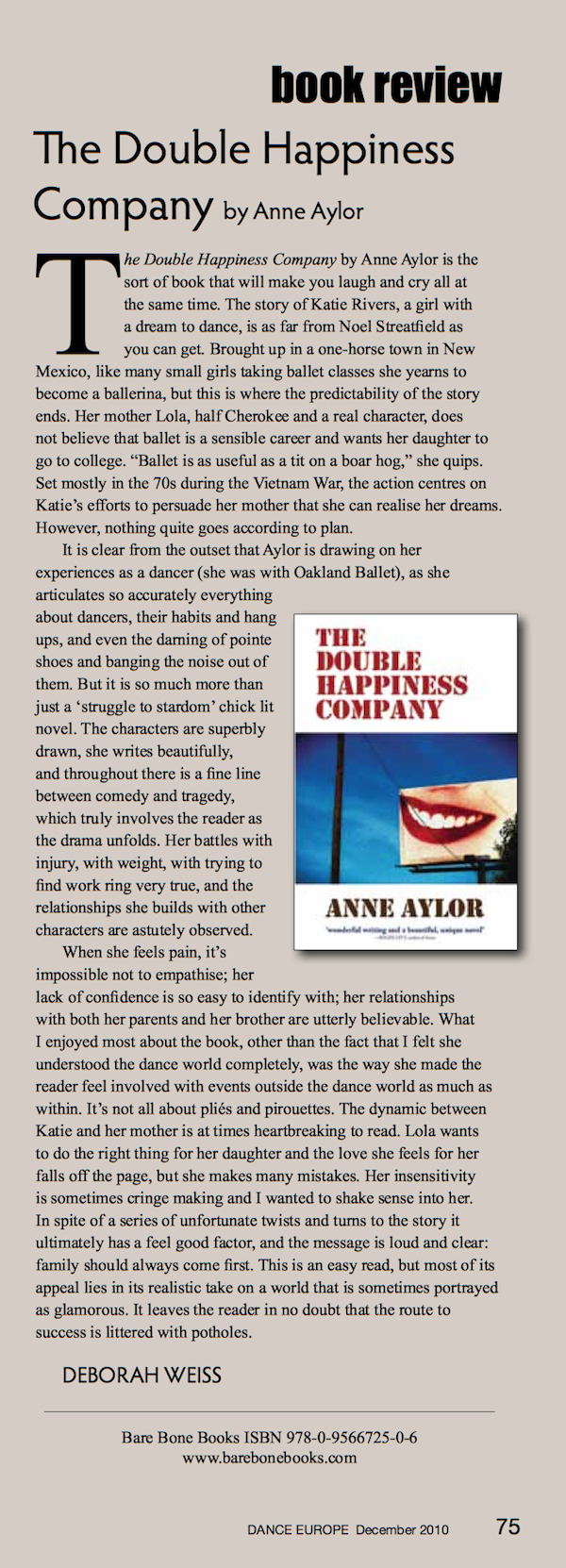
The December issue of Dance Europe contains this perceptive review by Deborah Weiss about our first publication. We are honoured The Double Happiness Company was the only book chosen for review in the magazine’s fifteenth anniversary edition. To view our 2.38-minute video trailer, click here.
If you can’t wait until the publication date of The Double Happiness Company on 27 January, there is an advance copy to be had from a bookseller in southeast England. Today I was amused to discover that a copy can be had now on eBay for £27.72! I presume that this must be a review copy sent out months ago and then sold to an online bookseller.
The “review run” had to go out in a rush in early September and, to BBB‘s embarrassment, we discovered errors which have subsequently been corrected. The funniest of these was the title from a Cecil B DeMille film, The Ten Commandments, which made it into the first print run as The Ten Commandants (which sounds like a movie about the Third Reich). Perhaps this misprint gives added cachet to those first early copies. If this review copy on eBay is sold at almost three times the RRP, the seller of Double Happiness will be trebly happy!
I have no beef about reviewers selling on books they have been sent; they are not well paid and I admire this reviewer’s entrepreneurial attitude. In fact, I am flattered that an unpublished title carries this inflated price as eBay normally offers items for sale under their market value. Have we started a trend? Do I hear any bids?
*for those of you not from Yorkshire, this is a pun on “eee by gum”, an exclamation of surprise . . .
We are pleased to announce a video trailer for Anne Aylor‘s The Double Happiness Company. It has been created with the help of the New York-based remixers, Eclectic Method. Enjoy!
It was interesting last weekend to read two contrasting articles about the state of ballet today. The first appeared in the Guardian Review where former ballet dancer, Jennifer Homan wrote ’in recent years I have found going to the ballet increasingly dispiriting. With few exceptions, performances are dull and lack vitality.’ The following day in The Observer Ruaridh Nicoll wrote that ‘Ballet is bursting with vitality, spilling beyond the doors of its traditional home in the great opera houses . . . Not only is there a huge amount of activity, there seems to be a growing audience to sustain it .’
Ballet originated in the 15th century, an import from Italy to France (the word comes from balletto, a diminutive of ballo, dance). This then-infant art form was introduced by Catherine de Medici, the new Queen of France, who also brought the civilising Italian custom of eating with forks rather than fingers.
Ballet’s popularity has waxed and waned ever since. Despite the great reforms of Jean-Georges Noverre in the eighteenth century, ballet went into decline in France after 1830 when dancers were relegated to being human statues near lake-side backdrops—les ballerines près de l’eau. Though dying out in France, ballet continued to flourish in Denmark, Italy and Russia. The art form came full circle when Serge Diaghilev brought the intoxicating Ballets Russes to its birthplace, Paris, in 1910.
Ballet has its pendulum swings, its last great upward movement in the 1980s. Homan may be right in saying we have lost our great choreographers, George Balanchine, Jerome Robbins, Frederick Ashton and Kenneth MacMillan, but the technical abilities of today’s artists are truly breathtaking. Witness the meteoric rise of ‘Rocket Man’, 21-year-old Ivan Vasiliev, in Don Quixote. Even if you hate ballet, this guy will make you gasp.
Someone from an earlier generation who is trying to imbue ballet with its original vitality and dramatic essence is the ballerina Gelsey Kirkland who has her own academy in New York City. I recently came across a video of her in Act I of Giselle, an astonishing performance as she was not dancing Giselle; she was Giselle.
Ten years ago, the film Billy Elliott caused a sensation and now, as a musical, is a permanent feature on stages around the world. Darren Aronofsky’s new film, Black Swan, is a psychological thriller about two ballerinas in Swan Lake. This movie returns ballet to the Big Screen. Its star, Natalie Portman, is being tipped for an Oscar.
The Double Happiness Company is not jumping on the bandwagon of this new ballet boom. The manuscript was started years ago, but has happily come into bloom now. It is a novel that places ballet in a physical and cultural wasteland. Its protagonist, Katie Rivers, desperately wants to escape it to dance and in Flaubert’s phrase, ‘to move the stars to pity’. This book begs to be filmed. Let the offers roll in.
I predict this will become an iconic photo. These girls, some with school ties bandoliered around their heads, have discovered their power as they attempt to prevent further destruction of this police van during the recent London student protests against fee rises and education cuts. Their peaceful intervention is wise beyond their years.
In our upcoming novel it is Katie Rivers, the book’s young protagonist, who seeks to heal a family divided by conflict. These ‘angelic spirits’ in Peter Marshall’s photograph are also determined to create a better future and have put themselves on the front line to make this happen. It’s an old story, but what a story.
One of the section chapters in The Double Happiness Company is a Spanish proverb: ‘No matter what happens in your life, nobody can take away your dance.’ The writer and poet, Maya Angelou, embodies this philosophy in her work and in her life. Enjoy her wonderful poem, ‘And Still I Rise’.
The Galaxy National Book Awards ceremony on November 11 was a red carpet affair held at BBC Television Centre. We thought you might be interested to read a condensed version of an article by Liz Thomson of BookBrunch:
‘There were some unexpectedly great moments at the Galaxy National Book Awards. Stephen Fry’s webcam was one of them, recorded from the perspective of one who thought he wouldn’t win and was just going through the whole charade to oblige. “I can say anything – I can say that publishers are prats, because no one’s going to see it because I won’t win,” he ventured, riffing on the theme before launching into a pastiche of the moment’s required niceties . . . in the event that he did, after all, win the award for Tesco Biography of the Year. And of course he did, beating, among others, Alan Sugar, Deborah Devonshire and Tony Blair. Mention of the former PM’s name provided another great moment, for it prompted some loud booing. The miscreant turned out to be David Wilson of indie publisher BareBone Books; in his previous life, Wilson handled press for the Stop the War Coalition . . .
Then there was Paul O’Grady, presenting the award for Sainsbury’s Popular Fiction Book of the Year. Picking up on an earlier mention of A Simples Life, the meerkat memoir, he lashed out at the nonsense, suggesting a biography of Churchill, the insurance dog, before heading off on to a rant about celebs unable to write their own memoirs yet unwilling to fess up to having worked with a ghost. O’Grady’s words are his own and he had worked for eight months, “sweating like a whore at confession”. His verbal aim last night was rather better than that of the student protestors, “who couldn’t get a brick through a window” . . .
“It’s for a TV audience – it will look fine when it’s edited” was the kindest verdict, oft-repeated at the after-show party. And no doubt it will. It’s just not one that book people will want to watch, other than those who were there, out of morbid curiosity and to see if the refreshing misbehaviour of Wilson, Fry and O’Grady makes the final cut.’
Photo: Liz Thomson (Anne Aylor & David Wilson at Galaxy Book Awards)
In this chapter of DHC, our debut publication, Katie Rivers, a ballet-mad teenager from a small town in New Mexico, comes face to face with the fierce Madame Feodorova. This demanding teacher has produced dozens of professional dancers, dazzling Katie who’s only studied with a cotton farmer.
This new recording of Chapter 4 features Madeleine Potter who has appeared in many films, including The Bostonians, The White Countess and The Golden Bowl. ‘Acrobat of God’ was directed by Tom Platten of Gilt & Grime. Recording engineer: Nico Bentley
Like Katie Rivers, the protagonist of our debut novel, The Double Happiness Company, Billy the Kid escaped from the territory of New Mexico at the age of twenty; Katie fled to study ballet in New York City. That is where the similarities end. Nearly a hundred years before, Billy escaped from gaol after standing trial for a murder he didn’t commit. During his sentencing, the judge told Billy that he would be hung until he was ‘dead, dead, dead’. To which the teenager replied, ‘And you can go to hell, hell, hell.’
Billy the Kid was fluent in Spanish, an accomplished dancer and a champion of the Latino poor whom he encouraged to stand up to the big ranchers who were exploiting them. Like so many in the Wild West, the dividing line beween law and lawlessness was blurred.
On her website about Billy, Marcelle Brothers wrote, ‘The men he killed weren’t angels, but were either bullies or outlaws. The Kid did steal livestock, but in some cases he either paid for, or returned, what he had taken. He even recovered stolen livestock for small ranchers and, judging by the poverty-stricken state he was always in, it seems he didn’t steal enough.’
There were cuthroats and murderers in the Wild West, outlaws that today no one has heard of because their terrible deeds are not worth remembering. But the Kid lives on in people’s imaginations, because of his youth (he was only 21 when he was killed by Sheriff Pat Garrett) and because he was the Robin Hood of the Chihuahuan Desert.
In the prologue to The Double Happiness Company Katie nurses dreams of becoming a great dancer in a small town that was a cultural, as well as a geographical desert: ‘Nobody knew she swanned around her bedroom pretending to be Anna Pavlova. If she had admitted this to anyone, they would only have laughed. Fortuna was a border town full of farmers and cowboys, not so many years away from Apache massacres, Billy the Kid and the law of the gun.’
I’ve been reading Quantum by Manjit Kumar, a smasher of a book about quantum mechanics (pardon the pun). It’s no coincidence that this eminently readable work was shortlisted for the BBC Samuel Johnson Prize for Non-Fiction in 2009.
There is a passage in the chapter, Quantum Reality, that reminded me of The Double Happiness Company because it encapsulates what DHC is about. When people ask me what themes this multi-dimensional book covers, the last thing they want is a long, rambling description as I struggle to compress a 300-page novel into a few neat phrases. To prevent their interest from fading and their eyes glazing over, from now on I’m going to say, ‘It’s a novel about entanglements.’
This is the moment to explain why Erwin Schrödinger, one of the fathers of quantum mechanics, has popped up in this post. Schrödinger used the word verschränkung, or entanglement, to describe the relations between particles that interact and then separate. Schrödinger believed ‘that in a two-particle system any changes to one particle would affect the other, despite the distance that separated them.’
The Double Happiness Company is a novel about one family that is pulled apart, yet remain entangled. This is a what happens in families everywhere and why this book is so powerful. You’ll have to read it to find out why.
BBB‘s first book, The Double Happiness Company, will be published in January. It has many themes: family, fate, weight and ballet. It is the last of these topics I will be exploring in this post, specifically Petrouchka, which is the Russian name for Punch (Pulchinella), the commedia dell’arte character. In DHC this ballet features prominently in the plot as it is danced by the novel’s protagonist, Katie Rivers, who hopes success in the title role will make her a star.
Diaghilev’s Ballets Russes premiered Petrouchka in 1911. With choreography by Michael Fokine, design and libretto by Alexander Benois and music by Igor Stravinky, it caused a sensation at its Paris opening and became one of the most famous ballets in the company’s repertoire.
The musicians who first had to play it, however, gave it a rather harsher reception. When Diaghilev wanted to perform Petrouchka two years after its première, the Vienna Philharmonic initially refused to play the score. They considered it schmutzige Musik (‘dirty music’) because of the dissonant tonality that was the musical signature of the ballet’s main character.
A YouTube clip from Scene II includes this ‘dirty music’. The role of Petrouchka is danced by the late, great Rudolf Nureyev.
Years ago, my wife stumbled across the longest, and most unusual, name she’d ever come across. It was that of an English leather merchant and Puritan preacher, Unless-Jesus-Christ-Had-Died-For-Thee-Thou-Hadst-Been-Damned Praise-God Barebone.
At the time, I was producing a film for BBC Arena about the role of artists in war. My new production company needed a name and Barebone Films was born. When setting up this press, I decided to resurrect the name, christened after the man who gave his surname to the Barebone’s Parliament of the English Commonwealth of 1653.
Welcome to BBB. And don’t worry. We’re a lot friendlier than our brimstone-eyed namesake!
I’ve had an eclectic career which has left me with a drawerful of dog-eared business cards. I have been a gaucho in Argentina, merchant seaman, lawyer’s clerk, teacher, art agent, truffle and prosthetic breast importer, computer software rep, TV film producer, playwright, aid worker, Director of the Pavarotti Music Centre*, whistle-blower, music and events organiser, Press Officer at Stop the War Coalition, journalist and now publisher.
It is appropriate that The Double Happiness Company is our first book. As a published author, Anne Aylor should have been taken by the majors. BBB has every reason to expect their future regret and our future delight. The novel is a can’t-put-down tale that splashes light on darkness. I expect its title to change when we get to the USA. When Anne’s first book was published in the UK as No Angel Hotel, her American publishers changed the title to Angel Hotel as ‘negative titles don’t sell’. Expect to see her new book appear there as The Triple Happiness Company.
Love this poster. Ché Guevara as a chihuaha. Or even better, Chi Guevara. My justification for having it here is because a chihuahua is a dog and a dog loves bones, etc, etc. We’re drawn to things a little off the wall at BBB. (No one would ever become a publisher unless they were barking mad or, at the very least, poco loco.)
So that explains the dog in a beret, jets shooting off skyward like fleas. Viva la publishing revolución! Viva Los Libros del Hueso Pelado!
And while I’m talking about chihuahuas, this breed is the oldest dog on the American continent and was considered sacred by the pre-Columbian Indians. Its native home is Mexico where it received its name from the state of Chihuahua. The breeds used to create the chihuahua aren’t known; some think it may have originated from the Fennec fox. My wife has a friend who owns a chihuahua. Her dog, Siou Mei, always wants to watch Eastenders, but no other TV show. Can anyone explain that? Obey the chihuahua.
Finis Jhung is a former soloist for the San Francisco and Joffrey Ballets and a principal dancer with the Harkness Ballet. Since 1972 he has been a mainstay of the New York dance scene, teaching at all the major New York studios, as well as at festivals, workshops and ballet competitions throughout the US and Europe. He is a master teacher who is dedicated to elucidating the principles of classical ballet technique, both in his classes in New York City and through his teaching videos.
Before he retired from the stage, he trained with many illustrious teachers, including Valentina Pereyaslavec, Vera Volkova, Stanley Williams, Erik Bruhn and Rosella Hightower. To read an interview with Finis on his journey from Hawaii to Broadway, click here.
Finis was chosen to coach the boys cast in the lead role in the Chicago production of Billy Elliot after the show’s choreographer, Peter Darling, and director, Stephen Daldry, saw Finis’ impressive teaching methods. To see him at work with the three Billys, click here.
This is what Finis said about The Double Happiness Company: ‘This is a wonderful book! It’s true-to-life and captures the thoughts and feelings of a dancer struggling with her family and career, past and present. And, as good dancing does, it will stir your memories and lift you up.’
Anne Aylor has had short stories published by the Arts Council of Great Britain, The Literary Review, London Magazine and Stand Magazine. She was twice an award winner in the Dixon-Ward Short Story Competition and an excerpt from her first novel, No Angel Hotel, was a winner in the BBC Radio 3 Short Story Competition. No Angel Hotel was published in the UK by HarperCollins and in the US by St Martin’s Press (title: Angel Hotel). The BBC have broadcast a number of Anne’s short stories, including one which became a chapter in The Double Happiness Company. In 2008 she was shortlisted for the Bridport Prize with her story, ‘The Speed of Dark’.
Her stage play, Children of the Dust, won a playwrighting award and was staged by the Soho Theatre and the Theatre Warehouse, Croydon (director: Terry Johnson). Her recent play, The Trainer, had a rehearsed reading in May 2009 at the Hackney Empire with Corin Redgrave, Tim Pigott-Smith, Roger Lloyd Pack and Janie Dee (director: Tom Platten).
She is the founder of Anne Aylor Creative Writing Courses which offers workshops in the UK and abroad. Anne has danced with the Oakland Ballet, worked in the Big Apple at the Salvation Army Trade Department, sold brass and wind music of the 17th and 18th centuries and practiced as an acupuncturist. Several years ago she gave up needles to concentrate on writing. She loves to teach because it doesn’t involve high maths or high heels.
James Wilson, designer of barebonebooks.com, has worked commercially as a web and multimedia designer and developer since 1999, architecting, designing and building a wide range of projects. These have included websites, microsites, intranets, content management and e-commerce systems, games, widgets, viral ad campaigns and multimedia presentations. His clients are both large and small, corporate and boutique.
James is the founder of Subtense, co-founder and technical director of PeaPancake and co-founder and creative director of We3commerce. He has worked for AOL, Heinz, ITV, Harrods, Holmes Place, Sony BMG, Vodafone, Opodo, Gumtree and Haymarket Publishing. among others. To see James’ portfolio, go to www.subtense.com
A short story by Anne Aylor entitled ‘The Double Happiness Company’ was commissioned and broadcast by BBC Radio 3. It was so well received that she realised there was mileage in the characters she had created and decided to expand the material into a novel.
Here you can listen to the BBC recording of what became Chapter 46. Click on anneaylor for more of her stories on BBC Radio.
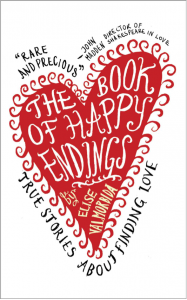
In this post the limelight falls on the multi-talented Elise Valmorbida. She is in the spotlight as our first imprint’s logo and book designer. She runs Word-Design, a design and writing agency. Elise is also a novelist and a teacher of creative writing at Central St Martins.
Honoured as a Trailblazer by the Edinburgh International Film Festival (2007), she is the producer of award-winning indie film Saxon, released in 2009.
Elizabeth Gilbert wrote Eat Pray Love which became a worldwide publishing phenomenon. In this TED talk she riffs about many things: the fear of success, about genius (what it meant in ancient Rome and how its meaning has changed), how Tom Waits reacted when the words to a new song came to him when he was driving. And most importantly, why the Spanish say Olé. Well worth 19 minutes of your time.
Christian Holder was a leading dancer with the City Center Joffrey Ballet from 1966 to 1979 where he worked with some of the choreographic masters of 20th century, including Jerome Robbins, Agnes de Mille, Alvin Ailey, Kurt Jooss and Leonide Massine. His eclectic repertoire ranged from The Green Table to Parade.
He appeared as guest solo dancer with San Francisco Opera from 1979 – 1981 and in ’81 choreographed their production of The Merry Widow with Dame Joan Sutherland. He performed in the 50th anniversity of the Chicago Joffrey Ballet’s production of Frederick Ashton’s Cinderella as one of the Ugly Sisters (pictured below with Gary Chryst).
Christian has choreographed and designed costumes for the Joffrey Ballet, Washington Ballet, Ballet Concierto de Puerto Rico, Ballet Théâtre de Bordeaux and American Ballet Theater. He has taught ballet for the Metropolitan Opera Ballet, ABT’s open class, Kaatsbaan International Dance Center, Ballet Arts Minnesota and Broadway Dance Center.
In 2001 Christian choreographed the San Francisco Opera’s production of Aida. To read his article in Dance Magazine celebrating the Joffrey Ballet’s 2006 golden anniversary, click here.
At BBB we are grateful that Christian was willing to read the 375-page typescript of a stranger and give The Double Happiness Company his endorsement.
BBB is grateful to three prominent members of the international dance world who were kind enough to read The Double Happiness Company and endorse it. The first of these is Rosanna Seravalli.
Rosanna joined the Joffrey Ballet shortly after her arrival in the US from her native Italy, before moving to American Ballet Theatre. She spent 11 years at ABT, dancing the classics and working with many of the most acclaimed choreographers of the last century, including George Balanchine, Jerome Robbins, Alvin Ailey, Anthony Tudor, Agnes de Mille, Frederick Ashton, José Limón and Leonide Massine. After leaving American Ballet Theater, she joined the faculty of the Conservatory of Dance at Purchase College where she is a tenured professor. She is also a faculty member of ABT’s Summer Intensive Program.
In 1984 she worked with the Cloud Gate Dance Theatre and the National Institute of the Arts in Taiwan and also taught at the Hong Kong Academy for Performing Arts. She received a SUNY Research Foundation Grant to travel to the former USSR to develop methods for adapting Russian classical training for American dancers. In 1995 she was awarded a Fulbright Fellowship to Chile to give seminars and master classes. In recent years, Rosanna has choreographed, staged productions and taught master classes for the Nanyang Academy of Fine Arts in Singapore. She has also consulted as an educator and ballet mistress with dance companies in the Philippines, Australia, Italy, South America and China.
This is what Rosanna had to say about BBB‘s first book: ‘Katie Rivers is a heroine for anyone who’s ever had a real dream. Coming from the most unlikely of places, the wastelands of the New Mexico desert, this ballerina in training pursues her destiny with a passion that is both admirable and reckless. This sweeping family saga, set against the background of the Vietnam War, takes the reader from the rural Southwest to the New York City of Katie’s dreams and back again, as a young girl and her family strive for resolution and confront their special demons. The Double Happiness Company is a wonderful story and a cautionary tale that will stay with readers long after they have set this compelling book down.’
In this TED talk the writer, Amy Tan talks about the mysterious process of writing. Some of the topics she covers in this 20-minute talk are how uncertainly is good, how Buddhist fishermen rationalise their occupation (‘saving fish from drowning’) and how Chinese ghosts have informed her writing. She is the author of novels such as The Joy Luck Club, The Kitchen God’s Wife and The Bonesetter’s Daughter.
The first person in the glare is Charles Boyle, polymath and poet. He had a long career with Faber and Faber (14 years in editing and production) and now works as a freelance editor which allows him more freedom to run the publishing company he set up, CB editions. Charles edited our first book and is shown here at the launch of one of his own publications, Elise Valmorbida’s The TV President.
Books are something Charles is fiercely passionate about. He has been kind enough to let me pick his brains about this publishing lark. He also writes a smashing blog. Click here for an interview with him.
From time to time at BBB, we will be spotlighting individuals who have made our books possible. It’s our small way of saying a big thank you to the people behind the scenes who are deserving of time ‘in the limelight’. But where exactly does the phrase come from?
In theatres and music halls, limelight used to be the primary focus of lighting on stage. Followspots used a block of lime which was heated until it became incandescent. Limelight is also, of course, a 1952 film written, directed by and starring Charlie Chaplin. His co-star was Claire Bloom. In the dance sequences, Bloom was doubled by the New York City Ballet ballerina, Melissa Hayden.