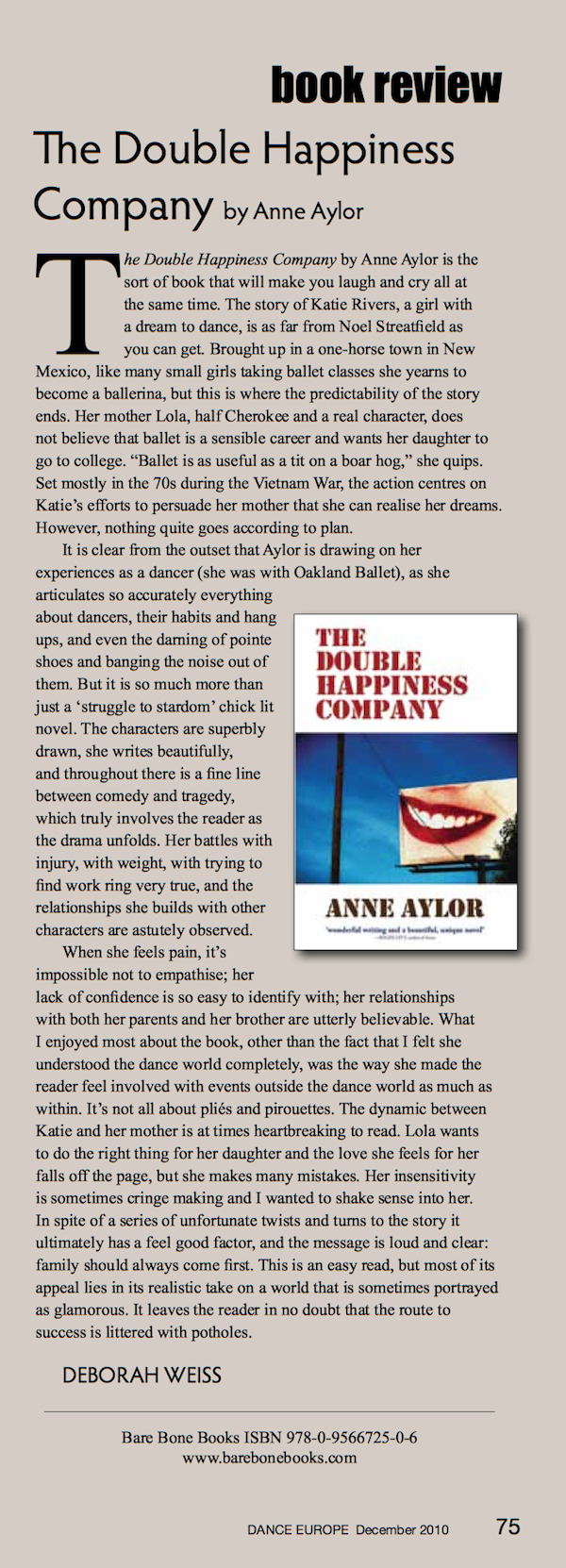
The December issue of Dance Europe contains this perceptive review by Deborah Weiss about our first publication. We are honoured The Double Happiness Company was the only book chosen for review in the magazine’s fifteenth anniversary edition. To view our 2.38-minute video trailer, click here.
If you can’t wait until the publication date of The Double Happiness Company on 27 January, there is an advance copy to be had from a bookseller in southeast England. Today I was amused to discover that a copy can be had now on eBay for £27.72! I presume that this must be a review copy sent out months ago and then sold to an online bookseller.
The “review run” had to go out in a rush in early September and, to BBB‘s embarrassment, we discovered errors which have subsequently been corrected. The funniest of these was the title from a Cecil B DeMille film, The Ten Commandments, which made it into the first print run as The Ten Commandants (which sounds like a movie about the Third Reich). Perhaps this misprint gives added cachet to those first early copies. If this review copy on eBay is sold at almost three times the RRP, the seller of Double Happiness will be trebly happy!
I have no beef about reviewers selling on books they have been sent; they are not well paid and I admire this reviewer’s entrepreneurial attitude. In fact, I am flattered that an unpublished title carries this inflated price as eBay normally offers items for sale under their market value. Have we started a trend? Do I hear any bids?
*for those of you not from Yorkshire, this is a pun on “eee by gum”, an exclamation of surprise . . .
We are pleased to announce a video trailer for Anne Aylor‘s The Double Happiness Company. It has been created with the help of the New York-based remixers, Eclectic Method. Enjoy!
It was interesting last weekend to read two contrasting articles about the state of ballet today. The first appeared in the Guardian Review where former ballet dancer, Jennifer Homan wrote ’in recent years I have found going to the ballet increasingly dispiriting. With few exceptions, performances are dull and lack vitality.’ The following day in The Observer Ruaridh Nicoll wrote that ‘Ballet is bursting with vitality, spilling beyond the doors of its traditional home in the great opera houses . . . Not only is there a huge amount of activity, there seems to be a growing audience to sustain it .’
Ballet originated in the 15th century, an import from Italy to France (the word comes from balletto, a diminutive of ballo, dance). This then-infant art form was introduced by Catherine de Medici, the new Queen of France, who also brought the civilising Italian custom of eating with forks rather than fingers.
Ballet’s popularity has waxed and waned ever since. Despite the great reforms of Jean-Georges Noverre in the eighteenth century, ballet went into decline in France after 1830 when dancers were relegated to being human statues near lake-side backdrops—les ballerines près de l’eau. Though dying out in France, ballet continued to flourish in Denmark, Italy and Russia. The art form came full circle when Serge Diaghilev brought the intoxicating Ballets Russes to its birthplace, Paris, in 1910.
Ballet has its pendulum swings, its last great upward movement in the 1980s. Homan may be right in saying we have lost our great choreographers, George Balanchine, Jerome Robbins, Frederick Ashton and Kenneth MacMillan, but the technical abilities of today’s artists are truly breathtaking. Witness the meteoric rise of ‘Rocket Man’, 21-year-old Ivan Vasiliev, in Don Quixote. Even if you hate ballet, this guy will make you gasp.
Someone from an earlier generation who is trying to imbue ballet with its original vitality and dramatic essence is the ballerina Gelsey Kirkland who has her own academy in New York City. I recently came across a video of her in Act I of Giselle, an astonishing performance as she was not dancing Giselle; she was Giselle.
Ten years ago, the film Billy Elliott caused a sensation and now, as a musical, is a permanent feature on stages around the world. Darren Aronofsky’s new film, Black Swan, is a psychological thriller about two ballerinas in Swan Lake. This movie returns ballet to the Big Screen. Its star, Natalie Portman, is being tipped for an Oscar.
The Double Happiness Company is not jumping on the bandwagon of this new ballet boom. The manuscript was started years ago, but has happily come into bloom now. It is a novel that places ballet in a physical and cultural wasteland. Its protagonist, Katie Rivers, desperately wants to escape it to dance and in Flaubert’s phrase, ‘to move the stars to pity’. This book begs to be filmed. Let the offers roll in.